

401(k) Rollover Guide for Cleveland Retirees
When Frank retired from his engineering job in Strongsville last year, he assumed the hardest part of retirement was behind him. Then a letter arrived from his old employer's plan administrator. It listed his 401(k) balance and a set of unfamiliar options: leave it where it is, roll it over, or cash it out. He called us the next day, unsure which box to check and worried about making an expensive mistake.
Frank isn't alone. Every year, trillions of dollars move out of employer-sponsored retirement plans as people change jobs or retire, and each of those dollars represents a decision that can shape a retiree's financial future for decades. The rollover decision is one of the most consequential, and most overlooked, choices in the entire retirement transition.
The good news is that this decision doesn't have to be confusing. In this guide, we'll walk through your four main options, the pros and cons of each, and the special considerations that might tip the scales one way or another. Whether you're in Strongsville, Shaker Heights, or anywhere across Northeast Ohio, our goal is to help you make a rollover decision you can feel confident about.
Understanding Your Rollover Options
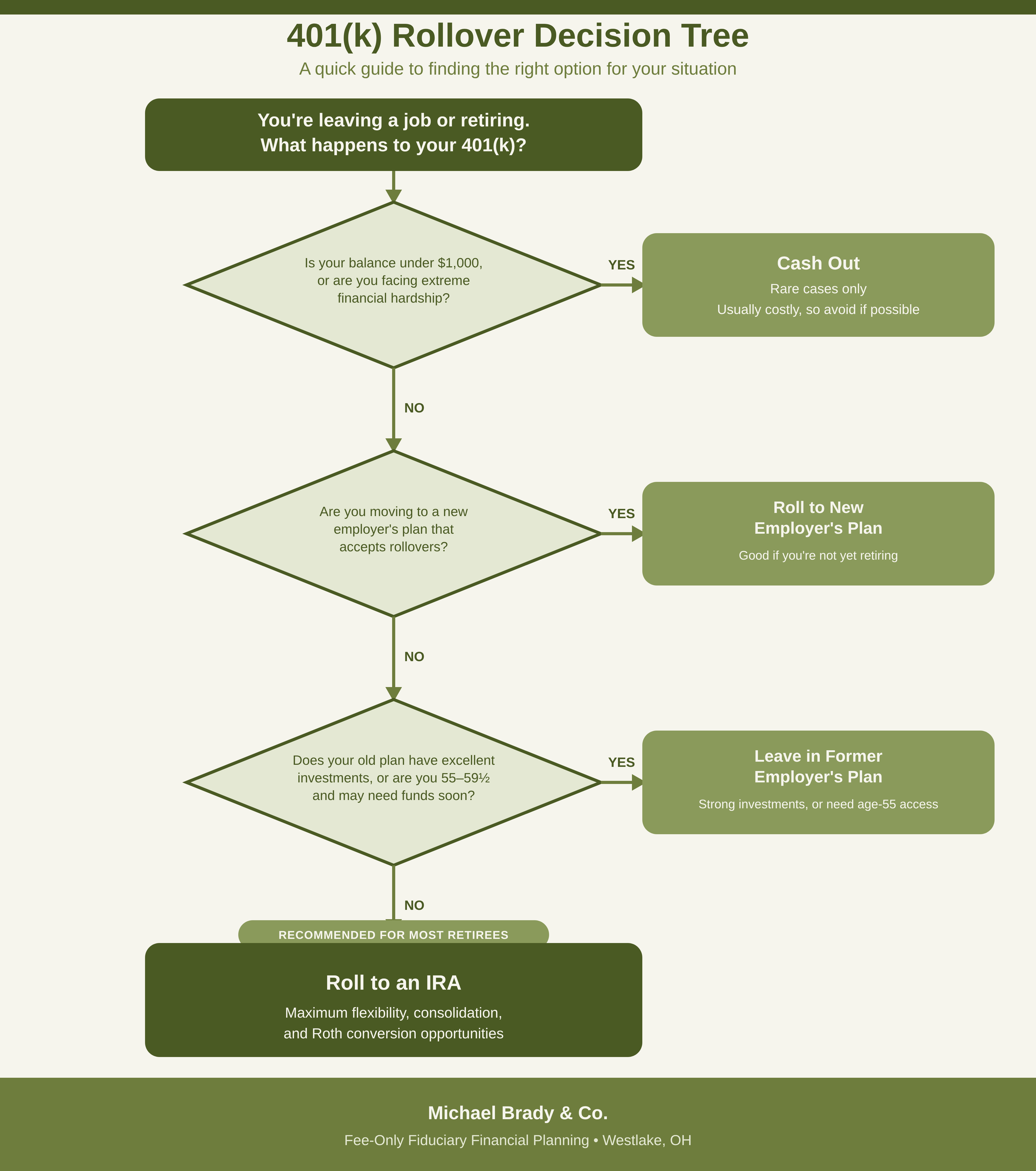
When you leave an employer, whether through retirement or a job change, you generally have four options for the 401(k) balance you've built up.
- Leave the money in your former employer's plan. In many cases, you can simply leave your balance where it is.
- Roll it over to your new employer's 401(k). If you're moving to a new job rather than retiring, some plans accept rollovers from your previous plan.
- Roll it over to an IRA. This moves your balance into an account you control directly.
- Cash it out. This is generally not recommended, for reasons we'll cover below.
There is no single right answer for everyone. The best choice depends on your fees, investment options, age, and broader financial plan. A few timing details matter too. If you ever receive a check made out to you rather than moving the funds directly, you have 60 days to complete the rollover before it's treated as a taxable distribution. That's why we always recommend a direct rollover, where the money moves from one institution to another without ever passing through your hands.
Option 1: Leaving Money in Your Former Employer's Plan
The advantages:
- No action required on your part
- You already know the investment lineup
- Some employer plans have institutional pricing that's hard to beat
- Your balance keeps strong creditor protection under federal law
- If you left your job at age 55 or later, you may be able to withdraw from that specific plan without the usual early withdrawal penalty
- In rare cases, if you're still working elsewhere, you may be able to delay required minimum distributions
The drawbacks:
- You're limited to whatever investment options the plan offers
- Fees can sometimes run higher than what you'd find in an IRA
- You lose a measure of control and flexibility
- If you have several old 401(k)s scattered across former employers, keeping track of all of them becomes its own project
- You can't add new contributions once you've left
When this makes sense: if your former employer's plan has genuinely excellent, low-cost investment options, if you're between 55 and 59 and a half and think you might need access to the funds, or if strong creditor protection is a priority for your situation.
We worked with a Cleveland-area executive whose former employer's 401(k) had access to institutional-class funds with fees a fraction of what he'd pay elsewhere. For him, leaving the money in place made sense, at least for now.
Option 2: Rolling to Your New Employer's 401(k)
If you're changing jobs rather than retiring, this can be a clean way to keep things simple.
The advantages:
- Consolidates your retirement savings into one account
- Potentially lower fees than an IRA, depending on the plan
- Maintains creditor protection
- Preserves the age-55 early withdrawal option if you leave that job later
- May be required if you're rolling over Roth 401(k) funds into another Roth 401(k)
The drawbacks:
- Your new employer's plan has to accept rollovers, which isn't guaranteed
- You're limited to that plan's investment menu
- Less flexibility overall compared to an IRA
When this makes sense: if your new employer offers a strong plan, if consolidation matters to you, or if you're not yet retired and want to keep building toward one account. Executing this option typically just requires a form from your new plan administrator and a request to your old plan to transfer the funds directly.
Option 3: Rolling to an IRA (Often the Best Fit)
For most retirees we work with, rolling into an IRA is the option that makes the most sense, though it isn't automatic and depends on your circumstances.
The advantages:
- Maximum flexibility in how your money is invested
- Often lower fees, though this depends on how the account is managed
- A natural way to consolidate several old 401(k)s into one account
- Easier to plan for beneficiaries
- Opens the door to strategic Roth conversions
- You can continue contributing if you're still earning income
- Access to professional management if you want it
- One statement instead of several
The trade-offs:
- You lose some creditor protection compared to a 401(k), though Ohio's IRA protections are relatively strong
- You lose the age-55 early withdrawal exception
- Fees can vary quite a bit depending on who manages the account
- Required minimum distributions still begin at age 73, with no ability to delay them even if you're working
When this makes sense: for most retirees, especially those who want more investment flexibility, who are already working with a financial advisor, or who have multiple old 401(k)s they'd like to bring together.
How the process works:
- Choose where you want your IRA held
- Open the account
- Request a direct rollover from your old 401(k) provider
- Confirm it's a direct transfer, not a check made out to you, to avoid the mandatory 20% withholding that applies to indirect rollovers
- Expect the transfer to take roughly two to four weeks
- Once the funds arrive, invest them according to your plan
One important detail: keep traditional and Roth funds separate. A traditional 401(k) rolls into a traditional IRA tax-free, and a Roth 401(k) rolls into a Roth IRA tax-free, but mixing the two creates a tax headache you don't need.
We recently helped a Westlake retiree consolidate three old 401(k)s from three different employers into a single IRA. What had been a confusing tangle of statements and login credentials became one account she could actually keep track of.
Option 4: Cashing Out (Generally Not Recommended)
Cashing out your 401(k) is almost always the most expensive choice on this list, and it's worth understanding exactly why.
When you cash out, the full balance becomes taxable as ordinary income in that year, which can push you into a federal tax bracket ranging from 22% to 37%. If you're under 59.5, add a 10% early withdrawal penalty on top of that. Then factor in Ohio state taxes. For example, a $200,000 cashout could easily cost more than $60,000 in combined taxes and penalties, money that's gone for good along with any future growth it might have earned.
There are a few rare situations where cashing out might genuinely be the right call, such as extreme financial hardship or a very small balance under $1,000 that isn't worth the hassle of rolling over. A Roth conversion is sometimes mistaken for cashing out, but it's a different transaction entirely: the money stays in a retirement account, just in a different form.
It's also worth knowing that if you leave a small balance and never act on it, some plans will automatically withdraw the money, sometimes into a low-yield account you didn't choose. We've seen retirees learn this the hard way after assuming a small old account could just be ignored.
Special Considerations Worth Knowing
A few details can significantly affect your decision, depending on your situation.
After-tax contributions in your 401(k): if you've made after-tax contributions, you may be able to split your rollover, sending the after-tax portion to a Roth IRA and the pre-tax portion to a traditional IRA. This is sometimes called a mega backdoor Roth strategy, and it can be a powerful tool for the right situation.
Company stock: if your 401(k) holds significant employer stock, a strategy called net unrealized appreciation, or NUA, may allow you to pay long-term capital gains rates on the stock's appreciation rather than ordinary income tax. This is a nuanced strategy best executed with guidance from both a financial advisor and a tax professional.
Outstanding 401(k) loans: if you have an outstanding loan against your 401(k) when you leave your job, you'll typically need to repay it, often within 60 days, or it will be treated as a taxable distribution.
The age-55 rule: this early withdrawal exception only applies to the plan of the employer you most recently separated from, at age 55 or later. It doesn't carry over once you roll the funds into an IRA.
Creditor protection: federal law provides strong protection for 401(k) balances. IRA protection varies by state, and Ohio's protections are relatively strong, but this is worth discussing if asset protection is a significant concern for you.
RMD timing: if you're turning 73 in the year you roll over, remember that you can't roll over your required minimum distribution. You'll need to take that RMD first, then roll over the remaining balance.
Multiple old 401(k)s: if you've changed jobs several times over your career, consolidating scattered old accounts can make your financial life meaningfully simpler and easier to manage.
Making Your Decision
Before you decide, it helps to ask yourself a few honest questions:
- What are the fees in my old 401(k) compared to what I'd pay in an IRA?
- How much do I value investment flexibility?
- Am I already working with a financial advisor who could help manage an IRA?
- Do I have several old retirement accounts I'd like to bring together?
- Am I between 55 and 59.5, and might I need access to these funds soon?
- Do I have after-tax contributions or company stock that need special handling?
Comparing expense ratios, administrative fees, and any advisor fees side by side is one of the clearest ways to see which option truly serves you best. From there, it's about weighing that information against your overall financial plan.
A Cleveland-area couple we worked with went through exactly this exercise. Once they laid out the fees and investment options side by side, the decision became much clearer than they expected.
How to Execute Your Rollover
Once you've decided, the process itself is fairly straightforward.
Preparation:
- Decide where the money is going
- Open your destination account ahead of time
- Gather your account information from the old plan
Execution:
- Request a direct rollover, not a check made out to you personally
- Complete the necessary paperwork with both the old and new custodians
- Confirm the transfer has been initiated
- Follow up to make sure it completes
After the rollover:
- Confirm the funds have arrived in the new account
- Invest according to your plan
- Update your beneficiary designations
- Keep documentation of the transfer for your records
Most direct rollovers complete within two to four weeks, though it's worth following up if you don't see the funds arrive on schedule. Keeping a folder, physical or digital, with your rollover paperwork can save you a headache later if any questions come up.
Working with a Fiduciary Advisor
A decision this significant benefits from a second set of eyes. A fiduciary advisor is required to act in your best interests, which means the guidance you receive focuses on what's right for you, not what generates a commission.
At Michael Brady & Co., we help Cleveland-area retirees weigh these options against their full financial picture, not just the rollover in isolation. We coordinate the rollover with your broader retirement income plan, and we continue managing the account after the transfer is complete. Our fee structure is simple and transparent, so you always know exactly how we're compensated.
If you're working with any advisor on a decision like this, it's worth asking directly how they're paid, whether they're a fiduciary, and how they'll coordinate the rollover with the rest of your financial plan.
The Bottom Line
Your 401(k) rollover decision will influence your fees, your flexibility, and your tax situation for years to come. For most retirees, rolling over to an IRA offers the clearest combination of control and flexibility, but the right answer always depends on your specific circumstances.
Take the time to understand your options before you act. If you'd like a second opinion on your own rollover decision, we're happy to walk through it with you.
Ready to make sense of your 401(k) options? Schedule a complimentary rollover consultation with our Cleveland-area team, and let's find the path that fits your situation.