

Asset Location Strategy: A Guide for Westlake Investors
When Tom and Linda first sat down with us, they had done almost everything right. (They're a hypothetical Westlake couple, but their story is one we see often.) They had saved diligently for 30 years, built a well-diversified portfolio, and kept their mix of stocks and bonds right where it should be for their risk tolerance.
There was just one problem. Their bonds sat in their taxable brokerage account, kicking off interest they paid tax on every April. Meanwhile, their stock index funds sat in their IRAs, where those low-tax returns and capital gains would one day be taxed as ordinary income. By simply swapping which investments were held in which accounts, without changing their overall mix at all, they reduced their annual tax drag by several thousand dollars.
Most investors spend a lot of energy on asset allocation: how much to hold in stocks, bonds, and cash. Far fewer think about asset location: which account each investment should live in. Allocation decides what you own. Location decides how much of the return you get to keep.
Over a 20- or 30-year retirement, that difference can add up to tens of thousands of dollars. In this guide, we'll walk through how asset location works, where different investments tend to fit best, and how Westlake and Cleveland-area families can put it to work.
Asset Location vs. Asset Allocation
Asset location is the practice of placing each investment in the type of account where it's likely to be taxed the least. It doesn't change what you own. It changes where you own it.
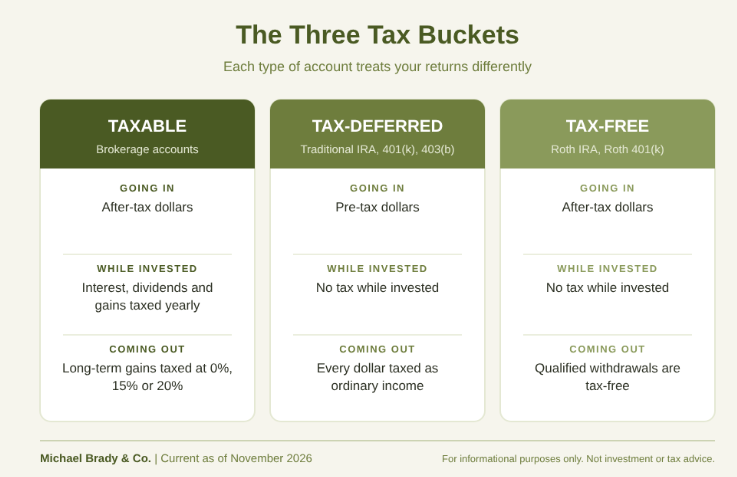
Most families we work with have money spread across three tax "buckets":
- Taxable accounts (brokerage accounts): You pay taxes each year on interest, dividends, and any realized gains. Long-term gains and qualified dividends are taxed at lower rates.
- Tax-deferred accounts (Traditional IRA, 401(k), 403(b)): No tax along the way, but every dollar you withdraw is taxed as ordinary income.
- Tax-free accounts (Roth IRA, Roth 401(k)): No tax along the way, and qualified withdrawals are tax-free.
Because each bucket treats returns differently, the same investment can produce very different after-tax results depending on where it sits.
Consider two hypothetical investors. Each has a 60/40 mix of stocks and bonds, split between a brokerage account and an IRA. Investor A holds bonds in the brokerage account and stocks in the IRA. Investor B does the opposite. Their allocation is identical, but Investor B pays less tax each year and is likely to end up with more after-tax wealth over time.
The goal is simple: put the right investment in the right account.
How Different Investments are Taxed
Some investments create a tax bill every year. Others let you defer taxes for a long time or pay at lower rates. Knowing the difference is the foundation of a good location strategy.
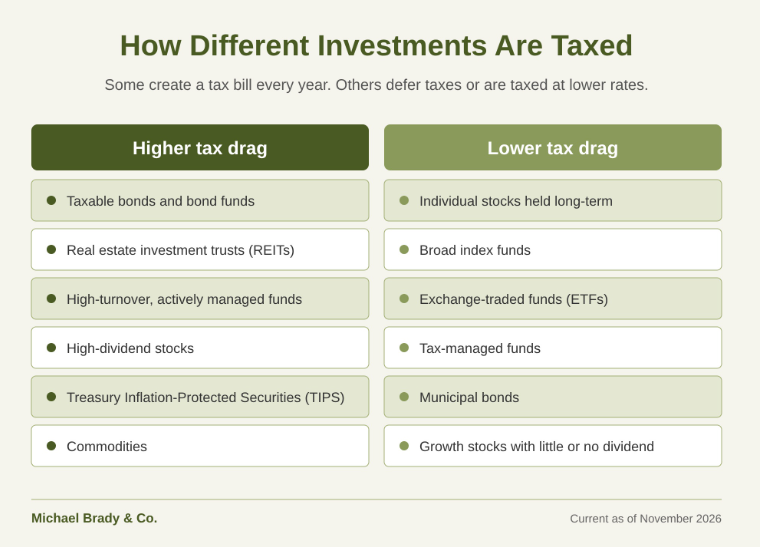
Why the difference? Bond interest, REIT payouts, and short-term gains are generally taxed as ordinary income, at federal rates as high as 37%. Qualified dividends and long-term capital gains are taxed at 0%, 15%, or 20%. Funds that trade often also pass along capital gains you didn't choose to take.
A hypothetical example: A $500,000 bond fund yielding 4% generates $20,000 of interest. In a taxable account, an investor in the 24% tax bracket owes about $4,800 in federal tax each year. The same $500,000 in a stock index fund yielding 1.5% in qualified dividends generates $7,500 in qualified dividends, taxed at 15%, or about $1,125.
A note for Ohio residents: Ohio taxes interest, dividends, and capital gains at the same rates as other income, so there's no state break for long-term gains. On the other hand, interest from Ohio municipal bonds is generally exempt from both federal and Ohio income tax.
Where Each Investment Tends to Fit Best
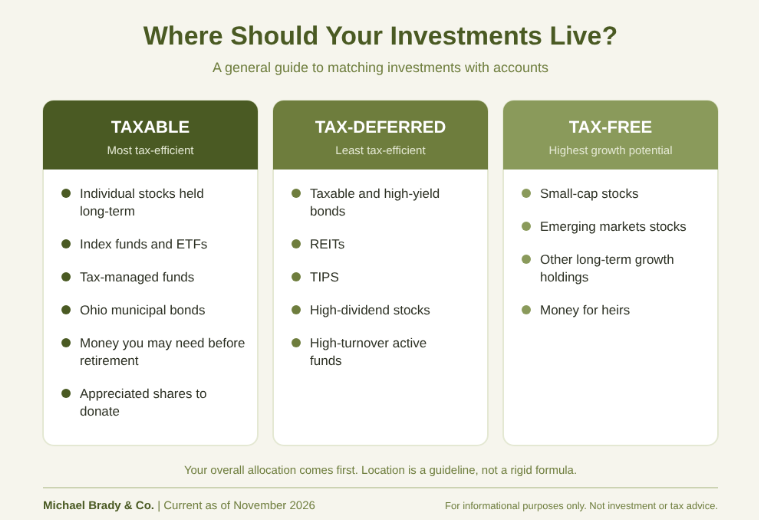
The general rule of thumb has three parts:
- Hold the least tax-efficient investments in tax-deferred accounts.
- Hold the most tax-efficient investments in taxable accounts.
- Hold your highest expected-growth investments in Roth accounts, where that growth may never be taxed.
Taxable accounts tend to suit individual stocks, index funds and ETFs, tax-managed funds, and municipal bonds. They're also a smart home for money you may need before retirement and for appreciated shares you may want to donate to charity, since gifting them can avoid the capital gains tax entirely.
Traditional IRAs and 401(k)s tend to suit taxable and high-yield bonds, REITs, TIPS, high-dividend stocks, and actively managed funds that trade often.
Roth IRAs tend to suit small-cap and emerging-market stocks, as well as other investments with the most long-term growth potential. They're also a strong choice for money you plan to leave to children, since qualified withdrawals are tax-free for heirs too.
Real-world constraints
Asset location is a guideline, not a rigid formula. Your overall allocation has to come first. Your 401(k) may offer only a handful of fund choices. One account may be much larger than the others, which limits how much you can shift. And selling holdings in a taxable account to reposition them can trigger taxes that outweigh the benefit.
Case study: A Cleveland physician
Consider Dr. Patel, a hypothetical Cleveland Clinic physician in her mid-50s with $2 million spread across a 403(b), a Roth IRA, and a taxable brokerage account. We kept the same core allocation in each account and made a few targeted adjustments within the bond portion. Less tax-efficient bonds, like taxable corporate bonds, went into her 403(b) and Roth IRA, where their interest isn’t taxed each year. In her taxable account, we used more tax-efficient bonds, such as Ohio municipal bonds. We also gave her Roth IRA a slightly higher stock allocation, since growth there is never taxed, and made a small offset in her 403(b) so her overall mix stayed on target. None of these changes were dramatic, but together they reduce the tax drag on her portfolio year after year. (Hypothetical example for illustration only. Actual results will vary.)
Asset Location in Retirement
Once you start drawing on your savings, asset location becomes part of a bigger question: which accounts do you pull from, and when? A coordinated approach can help you:
- Sequence withdrawals across taxable, tax-deferred, and Roth accounts to manage your taxable income year by year.
- Pair location with Roth conversions. Converting assets with high growth potential can move more future growth into the tax-free bucket.
- Manage Required Minimum Distributions (RMDs). Holding slower-growing bonds in your IRA can help keep that balance, and your future RMDs, in check.
- Watch Medicare premiums. Higher income can trigger Income-Related Monthly Adjustment Amounts (IRMAA), which are surcharges added to Medicare Part B and Part D premiums. Keeping taxable income steady helps avoid them.
- Harvest losses in taxable accounts during down markets to offset gains elsewhere.
- Plan your legacy. Heirs generally receive a step-up in cost basis on taxable assets and tax-free Roth dollars, while inherited IRAs are taxed as income.
For example, a hypothetical Westlake retiree might rebalance inside her IRA rather than her brokerage account, avoiding capital gains, while drawing living expenses from taxable dividends and a planned annual Roth conversion.
Common Asset Location Mistakes
- Flipping it backward: stocks in the IRA, bonds in the taxable account.
- Ignoring location altogether and treating each account as a separate portfolio.
- Letting the tax tail wag the dog by chasing small tax savings at the expense of a sound allocation.
- Forgetting about RMDs and letting the IRA grow faster than your future tax plan can handle.
- Not coordinating between spouses, when two sets of accounts should work as one household plan.
- Overlooking Ohio taxes, including the value of Ohio municipal bonds.
- Ignoring trading costs and the taxes triggered by repositioning.
- Setting it and forgetting it. Your location strategy should evolve as your life and tax laws change.
How Your Strategy Changes Over Time
The right location strategy shifts as you move through each stage of life.
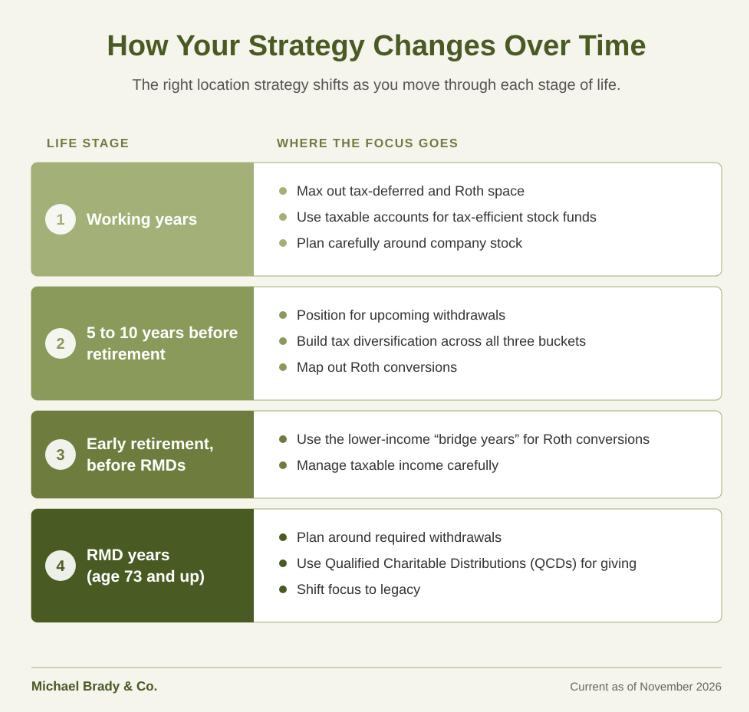
A hypothetical Cleveland executive might hold mostly stock funds in her taxable account at 50, start building bond positions inside her 401(k) at 58, convert IRA dollars to Roth in the years between retirement and RMDs, and then use QCDs from her IRA to support the causes she cares about in her 70s.
Putting it Into Practice
If you want to see whether your accounts are working together, here's a simple framework:
- Assess. List every account, its balance, its tax type, and what it holds.
- Plan. Confirm your target allocation first, then decide where each piece fits best within your constraints.
- Execute gradually. Make changes inside IRAs and 401(k)s first, where trades don't trigger taxes. In taxable accounts, use new contributions, dividends, and tax-loss harvesting to shift over time.
- Monitor. Review the strategy once a year and after major life or tax law changes.
A hypothetical Westlake couple might complete steps one and two in a single planning meeting, rebalance their IRAs that same week, and phase in taxable account changes over the next two to three years.
Special considerations
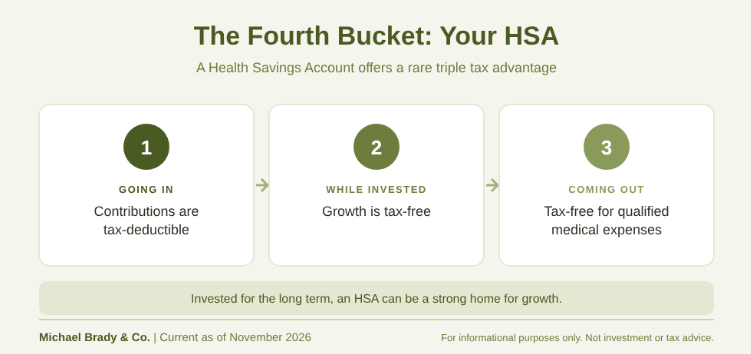
- Health Savings Accounts (HSAs) act as a fourth tax bucket: tax-deductible contributions, tax-free withdrawals for qualified medical expenses. They can be a great home for long-term growth.
- 529 plans are typically earmarked for education, but they belong in your overall household picture. Ohio residents can also deduct contributions to Ohio's 529 plan on their state return.
- Concentrated employer stock in a 401(k) may qualify for special tax treatment called Net Unrealized Appreciation (NUA). Review this before any rollover. (See our 401(k) Rollover Guide.)
- Annuities, alternatives, and cryptocurrency each have their own tax rules and should be evaluated on a case-by-case basis.
Why a Fiduciary Advisor Can Help
Asset location sounds simple on paper. In practice, it means projecting taxes years into the future, balancing competing goals, and coordinating every account in your household. That's where professional guidance pays off.
As fee-only fiduciaries, we always act in your best interest. We use tax projection and portfolio modeling to see how your accounts work together, then build a strategy tailored to your goals. And because the right answer changes as your life does, we revisit it with you every year.
The Bottom Line
Asset location is one of the few ways to potentially improve your after-tax returns without taking on more risk. It works alongside a sound asset allocation, not in place of it. If you've never looked at where your investments live, now is a great time to start.
Ready to see how tax-efficient your portfolio really is? Schedule a portfolio tax efficiency review.