

Medicare Enrollment Timeline: What Pre-Retirees Should Know
A Westlake retiree we recently spoke with assumed Medicare enrollment would happen automatically when she turned 65. It didn't. By the time she realized her mistake, she had missed her enrollment window entirely. The result was a permanent penalty added to her Part B premium, one she will pay for the rest of her life.
Her story is more common than you might think. Medicare enrollment rules are confusing, the deadlines are unforgiving, and the penalties for missing them never go away. The good news is that the timeline, once you understand it, is entirely manageable. This guide walks through exactly when to act and what to watch for, whether you are retiring at 65 or continuing to work past it.
Medicare Basics
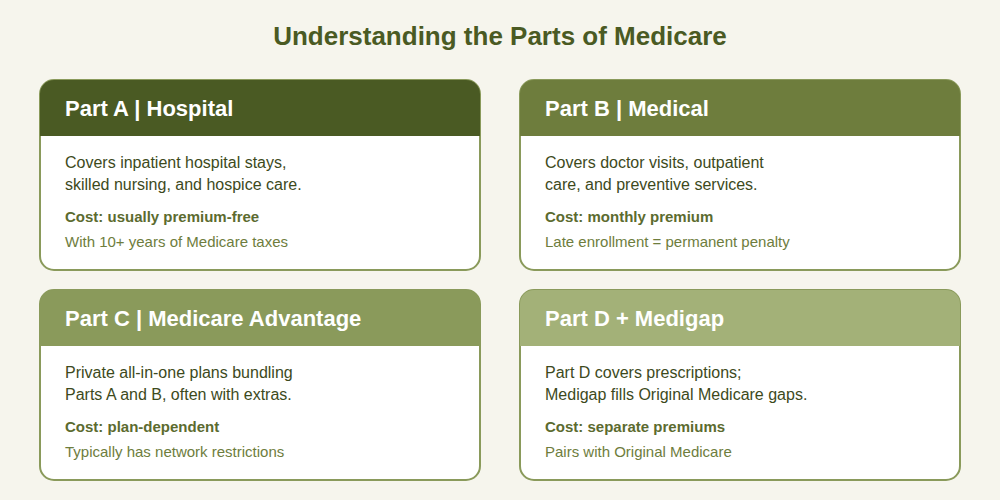
Medicare has several parts, and understanding them is the foundation for everything else. Part A covers hospital insurance and is usually premium-free if you or your spouse paid Medicare taxes for at least 10 years. Part B covers medical insurance, such as doctor visits, and has a monthly premium. Part C, known as Medicare Advantage, is a private-insurer alternative that bundles Parts A and B, often with extras. Part D covers prescription drugs. Medigap is supplemental coverage that works alongside Original Medicare to cover gaps in coverage, such as copays and deductibles.
Eligibility generally begins at 65, and how Medicare coordinates with any other coverage you have, whether through an employer, a spouse, or COBRA, depends heavily on timing. Getting that timing wrong is where the penalties come in.
The Initial Enrollment Period
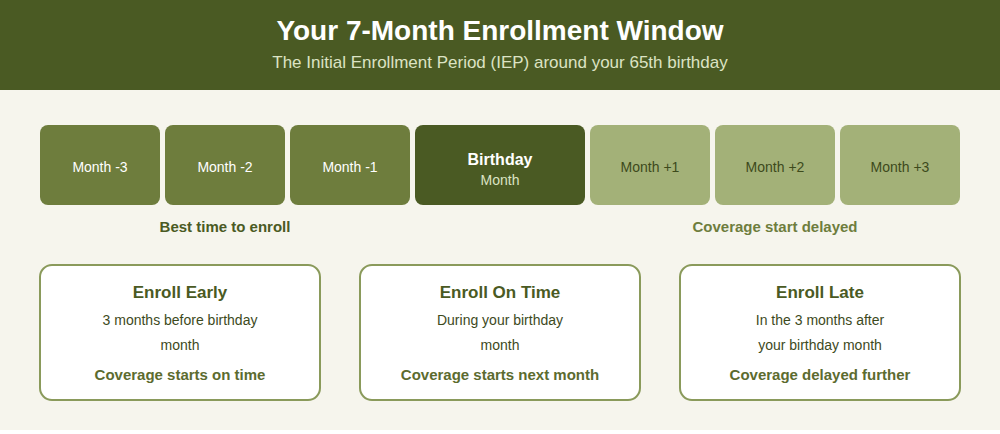
Your Initial Enrollment Period, or IEP, is a seven-month window: three months before your 65th birthday month, your birthday month itself, and three months after. This is the window most people use to enroll.
Timing within that window matters. Enroll in the three months before your birthday month, and coverage starts the month you turn 65. Wait until your birthday month or after, and your coverage start date gets pushed back, sometimes by several months. For a Rocky River or Bay Village resident turning 65 in June, for example, enrolling in March means coverage begins in June. Waiting until June or later delays things unnecessarily.
The recommended approach is simple: enroll three months before your birthday month whenever possible, so your coverage begins exactly when you need it with no gap.
Still Working? A Different Set of Rules Applies
If you are still working at 65 and have coverage through an employer with 20 or more employees, you may be able to delay Part B without penalty. This is one of the most important and most misunderstood parts of Medicare planning.
Here is what matters: you generally still need to enroll in Part A if it is premium-free, since there is little downside to doing so. Part B can typically be delayed penalty-free as long as your employer coverage qualifies as creditable. Once that employment or coverage ends, you get an eight-month Special Enrollment Period to sign up for Part B without penalty. Missing that window, even by a little, can mean lasting penalties.
There is one coordination issue that catches people off guard: you cannot contribute to a Health Savings Account once you are enrolled in any part of Medicare, including Part A. If you plan to keep contributing to an HSA while working past 65, you need to stop those contributions at least six months before applying for Medicare, because Part A enrollment can apply retroactively.
We worked with a Westlake executive who continued working until 68. Because his employer coverage qualified, he delayed Part B with no penalty and timed his HSA contributions carefully around his eventual enrollment. Getting this sequence right protected him from costly mistakes that catch many later retirees off guard.
If You Miss Your Window: The General Enrollment Period
If you miss your Initial Enrollment Period and do not qualify for a Special Enrollment Period, you will need to wait for the General Enrollment Period, which runs from January 1 through March 31 each year. Coverage does not begin until July 1, leaving a real gap.
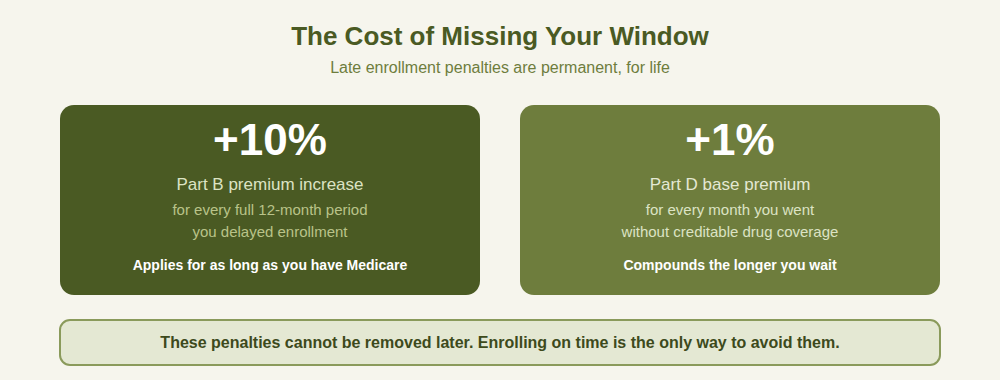
The penalties here are significant and permanent. Part B carries a 10% premium increase for every full 12-month period you were eligible but did not enroll, and that penalty applies for as long as you have Medicare. Part D penalties accrue similarly, around 1% of the national base premium for every month of delay. Someone who waited three years past eligibility could be paying a substantially higher premium for the rest of their life. There is no way to undo this once the window has passed, which is exactly why timing matters so much from the start.
Choosing Your Path: Medicare Advantage or Original Medicare with Medigap
During your enrollment window, you also need to decide how you want your coverage structured. Medicare Advantage plans bundle everything into one private plan, often with added benefits like dental and vision, but typically come with network restrictions. Original Medicare paired with a Medigap supplemental policy offers more flexibility to see providers without network limits and more predictable costs, but requires a separate Part D plan for drug coverage.
This decision matters because switching later is limited. Medigap comes with a guaranteed issue period of 6 months from the date your Part B becomes effective. After that window closes, insurers can use medical underwriting to deny coverage or charge more. Make this decision deliberately during your IEP rather than defaulting into it.
Your Enrollment Checklist
A practical timeline looks like this: at 12 months before turning 65, review your current coverage and how it will interact with Medicare. At 6 months before, research your plan options, whether Advantage or Original Medicare with Medigap. At 3 months before, complete your enrollment, notify your employer if you are still working, choose your Part D plan, and confirm your coverage effective date.
Why This Belongs in Your Broader Retirement Plan
Medicare decisions do not exist in isolation. They interact with your Social Security claiming strategy, your retirement income plan, and decisions about coverage from a spouse's employer or COBRA. A financial advisor who understands these moving pieces can help you sequence them correctly so nothing falls through the cracks.
The stakes here are real, and the penalties are permanent. Planning ahead is the only way to avoid them.
If you are approaching 65 and want to make sure your Medicare timeline is mapped out correctly, schedule a Medicare planning review with our Westlake team. We will walk through your specific situation and make sure you enroll at the right time, the first time.