

The 5-Year Retirement Countdown: What to Do and When
When Dave and Susan sat down with us last spring, they had one regret: they wished they'd started planning five years earlier. Dave, an engineer at a Westlake manufacturing firm, had always assumed retirement planning was something you tackled a year or two before you walked out the door. By the time they came to see us, several opportunities, including a window for strategic Roth conversions, had already closed.
Their story is more common than you might think. Retirement has a way of sneaking up on even the most organized people. One year you're deep in your career, and the next, you're staring down a date on the calendar with more questions than answers.
That's why we recommend thinking of retirement planning as a five-year process, not a last-minute checklist. Five years gives you enough runway to make thoughtful adjustments, take advantage of tax-planning opportunities, and walk into retirement with confidence rather than scrambling.
In this guide, we'll walk you through exactly what to focus on at each stage of the countdown, from five years out to your very first month of retirement. Whether you're in Westlake, Rocky River, or anywhere across Northeast Ohio, this timeline will help you know what to do and when to do it.
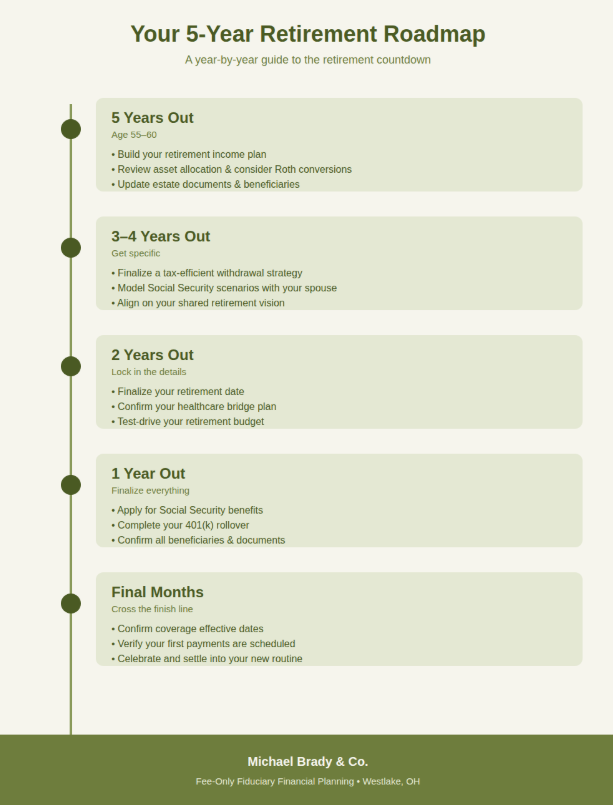
Why Start Five Years Out?
Five years might sound like a long runway for retirement planning, but it's actually the sweet spot. It's long enough to make meaningful course corrections and short enough for your plan to stay realistic and actionable.
Here's what that extra time buys you:
- Room for course corrections. If your savings are behind where they need to be, five years gives you time to adjust your contributions, your investment mix, or even your target retirement date.
- Strategic tax moves. Roth conversions, for example, often make the most sense when spread out over several years rather than done all at once. The earlier you start, the more flexibility you have.
- Less last-minute stress. Families who plan early tend to feel calmer as retirement approaches, because the big decisions are already handled.
- More retirement options. Whether that means retiring earlier than planned, working part-time, or having more flexibility in how you draw down your accounts, planning ahead widens your choices instead of narrowing them.
The cost of waiting is real. Families who start planning only a year or two out often find themselves with fewer options and more pressure to make decisions quickly. Five years lets you approach retirement deliberately instead of reactively.
5 Years Before Retirement (Age 55–60)
This is the stage where big-picture planning begins.
Financial tasks:
- Calculate your expected retirement expenses
- Estimate income from all sources, including Social Security, pensions, and investments
- Identify any gaps between expected income and expenses
- Review your investment asset allocation
- Consider Roth conversion opportunities
- Boost savings if you're behind on your goals
- Review beneficiary designations on all accounts
Healthcare planning:
- Research early retirement healthcare options
- Build up your HSA balance if you have access to one
- Consider whether long-term care insurance makes sense for your situation
Estate planning:
- Update or create a will
- Establish power of attorney documents
- Review whether a trust fits your goals
Social Security:
- Create your my Social Security account and review your earnings record
Career decisions:
- Evaluate pension options if your employer offers one
- Consider whether a phased retirement makes sense for you
Take a Westlake executive we worked with, for example. Five years from his target retirement date, he assumed his pension and 401(k) alone would cover his lifestyle. Once we ran the numbers together, we identified a gap and had time to close it gradually, without making drastic changes all at once.
Key questions to answer at this stage: What does retirement actually look like for you? Are you on track? If not, what needs to change?
3 to 4 Years Before Retirement
With the big picture in place, this stage is about getting specific.
Financial tasks:
- Meet with your financial advisor to build a retirement income plan
- Develop a tax-efficient withdrawal strategy
- Continue Roth conversions if they still make sense
- Pay down high-interest debt
- Consider the pros and cons of paying off your mortgage before retiring
- Review and adjust your investment portfolio
- Calculate your future required minimum distributions (RMDs)
Healthcare planning:
- Refine your healthcare coverage plan
- Continue funding your HSA
- Review your Medicare options and timeline
Social Security:
- Analyze claiming strategies and model different scenarios with your spouse
- Decide on a tentative claiming age
Lifestyle planning:
- Discuss your retirement vision with your spouse
- Consider where you want to live, whether that's staying in Cleveland or relocating
- Identify the activities and sense of purpose that will fill your days
- Build a realistic budget for your retirement lifestyle
Estate planning:
- Review and update your documents
- Consider funding any trusts you've established
A Cleveland couple we worked with used this stage to have honest conversations about what they each wanted retirement to look like. It turned out their visions weren't quite aligned, and having that conversation three years out gave them time to find common ground before it became a source of stress.
Milestone checklist for this stage: a tentative income plan, a tentative Social Security strategy, and a shared vision of what retirement looks like for both spouses.
2 Years Before Retirement
Retirement starts to feel real at this stage, and the details matter.
Financial tasks:
- Finalize your retirement date
- Complete your pension decision analysis
- Solidify your withdrawal strategy
- Create a retirement budget
- Set up an emergency fund covering one to two years of expenses
- Review insurance needs, including life, disability, and long-term care coverage
Healthcare planning:
- Finalize your bridge coverage plan
- Confirm your Medicare enrollment timeline
- Research Medigap or Medicare Advantage options
Social Security:
- Finalize your claiming strategy and coordinate with your spouse
- Understand the tax implications of your benefits
Employer coordination:
- Notify your employer of your retirement date
- Understand which benefits will end
- Review any severance or retirement package details
- Confirm your pension details
- Plan your 401(k) rollover
Lifestyle planning:
- Test your retirement budget in real life
- Explore new activities and hobbies
- Build social connections outside of work
A Westlake physician we worked with used this stage to test-drive his retirement budget for six months while still working. That trial run gave him the confidence that his plan would hold up once his paycheck stopped.
1 Year Before Retirement
This is the year to finalize everything.
Financial tasks:
- Review your entire financial plan
- Confirm you have adequate cash reserves
- Set up a systematic withdrawal plan
- Arrange your 401(k) rollover if you're not staying with your employer's plan
- Make your final pension decision
- Adjust your investment allocation for retirement
- Review your tax withholding strategy
Healthcare:
- Enroll in bridge coverage if needed
- Set up your HSA distribution plan
- Prepare for Medicare enrollment if applicable
Social Security:
- Apply for benefits three to four months before your intended start date
- Confirm beneficiary information
Employer tasks:
- Complete retirement paperwork
- Understand any retiree benefits available to you
- Plan your exit transition
- Archive important work documents
- Arrange your final paycheck and benefits
Estate and legal:
- Complete a final review of all documents
- Confirm beneficiaries on every account
- Organize your financial documents in one place
Lifestyle:
- Plan your first year of retirement
- Adjust to a new schedule gradually
- Maintain the connections and sense of purpose that matter to you
For one Cleveland couple, this final year was about tying up loose ends. Every document was reviewed, every account was confirmed, and by the time retirement day arrived, there were no surprises left.
The Final Months
60 days before:
- Confirm all paperwork has been submitted
- Set up direct deposit for pension or Social Security payments
- Arrange your health insurance coverage
- Complete your 401(k) rollover
30 days before:
- Have a final meeting with your financial advisor
- Review your retirement income plan one more time
- Confirm your first month's cash flow
- Update your address and contact information where needed
Retirement day:
- Confirm your coverage effective dates
- Verify that your first payments are scheduled
- Celebrate. You've earned it.
First month:
- Monitor your account transfers
- Adjust spending as needed
- Settle into your new routine
One Westlake couple described their first month of retirement as a mix of excitement and adjustment. Having a plan in place for those first few weeks made the transition feel manageable instead of overwhelming.
Cleveland-Area Resources
You don't have to navigate this alone. Northeast Ohio has plenty of resources to support your retirement transition, including:
- Local Social Security office locations for in-person questions
- Medicare resources available throughout Ohio
- Senior centers and activities in the Westlake area
- SCORE and other volunteer opportunities for retirees looking to stay engaged
- Cleveland Clinic wellness programs
- Continuing education opportunities across the region
Common Retirement Planning Mistakes
As you work through your own countdown, keep an eye out for these common pitfalls:
- Starting the planning process too late
- Underestimating retirement expenses
- Poor timing on Social Security claiming
- Ignoring healthcare costs until the last minute
- Not having a clear withdrawal strategy
- Failing to plan for taxes in retirement
- No plan for how you'll spend your time and find purpose
- Not communicating openly with your spouse about retirement goals
The Bottom Line
Retirement doesn't have to feel like a leap into the unknown. A systematic, five-year approach gives you time to make thoughtful decisions rather than rushed ones, and it allows you to optimize your Social Security claiming, tax strategy, and overall plan.
Wherever you are in your own countdown, whether that's five years out or five months out, the most important step is simply to start.
Ready to build your own retirement countdown plan? Schedule a complimentary consultation with our Westlake-based team, and let's map out your path to retirement together.